
Refillable Leather Journal: Keep the Cover, Swap the Pages
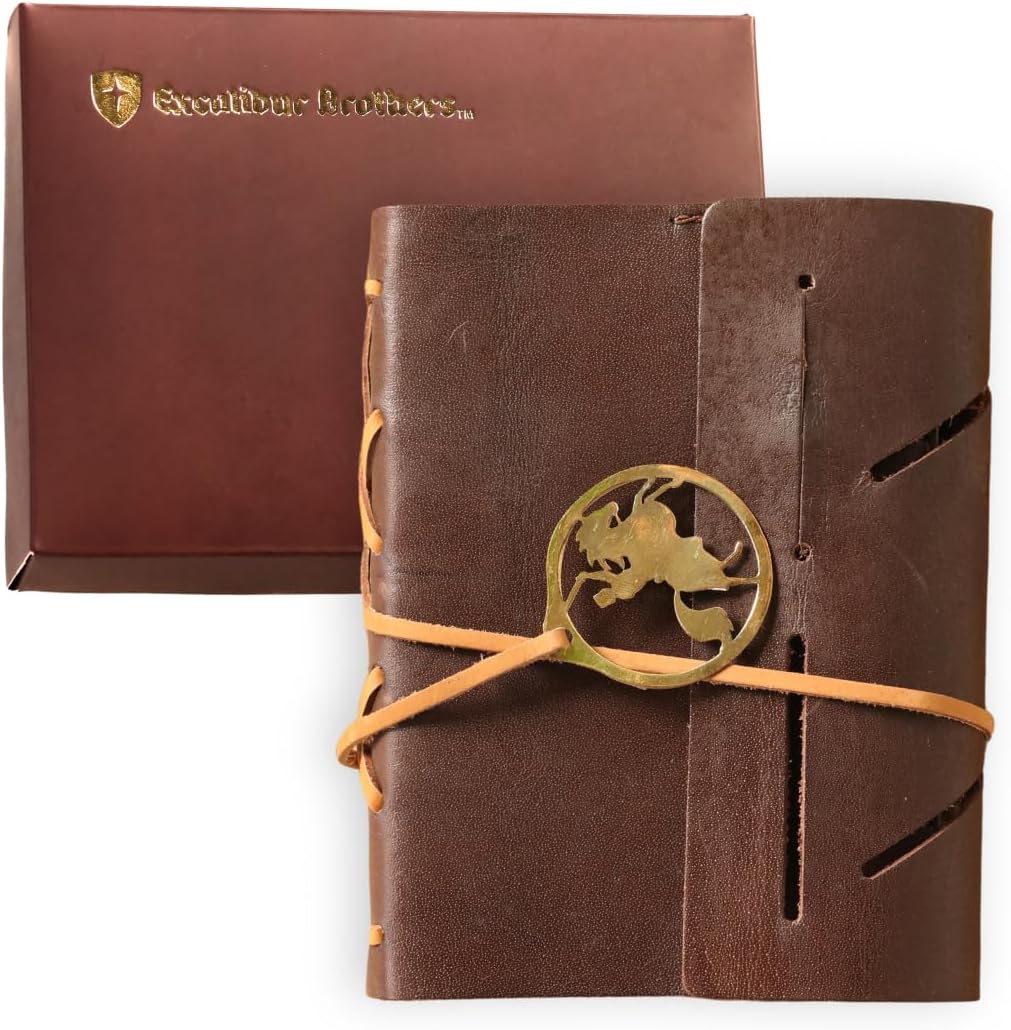
Premium Leather Journal for Men $14.95 · 4.6★ · 7 Amazon reviews
A6 buffalo leather cover in dark brown, with a 100-page ivory insert that comes out when you've filled it. The 4.6 stars sit on seven reviews, which is a thin sample, so buy it on the spec rather than the rating.
What you get
- Cover: buffalo leather, dark brown
- Size: A6, 4.3 × 5.9 inches, roughly 109 × 150 mm
- Insert: 100 pages of ivory paper, removable and replaceable
- Pen loop
- Bookmark ribbon with the EB emblem on it
- Keepsake box
That's the entire list. The leather is the product here and the paper is a consumable that happens to ship with it, which is the right way round for anyone who writes more than a few pages a month.
What a leather journal is used for
Most people use one in one of two ways. Either as a daily record, a few lines about what happened and what you decided, or as a capture tool: the thing you write the number on when someone reads it out and you've got no signal. Both work better in leather than in a paper-cover notebook, because leather survives being sat on.
Two more uses earn the cover rather than the paper. Travel, where a notebook that doesn't need charging beats a phone at customs and on planes. And work, where a pocket book on the table in a meeting reads differently from a laptop lid.
If you're starting from zero and the habit has never stuck before, we wrote up how to start journaling as a man for exactly that.
Leather bound journal vs refillable: keep the cover, swap the pages
A leather bound journal has its pages sewn or glued into the leather. Fill it and you're done; it goes on a shelf and you buy another one. A refillable journal is a cover with a paper block inside that lifts out.
The case for refillable is arithmetic. You pay for the hide once. After that you're buying paper, and paper is the cheap part of any notebook by a wide margin. Fill four books a year for five years on a bound-journal habit and you've bought twenty leather covers you didn't need.
There's a second argument that matters more than the money. Leather gets better with use: it darkens where your hand sits, it softens, the grain sharpens up where it creases. Paper doesn't do any of that. Paper goes yellow and dog-eared and then it's full. Tying the two together on the same lifespan wastes the half that was improving.
The case for bound: if you reread old journals, a shelf of matching leather books is a better object than a shelf of loose inserts. Some people want the archive to look like an archive. Buy accordingly.
It's a leather notebook cover: which inserts fit
Think of this as a leather notebook cover that happens to arrive with its first insert included. When that one's full, you're shopping for A6 refills, which is a standard size sold by dozens of stationers at 105 × 148 mm.
Two specs decide whether a refill works in a cover this size.
Page count. The cover was built around a 100-page block. A 200-page insert is roughly twice as thick and will either sit proud of the edges or strain the fitting. Match the original thickness and you'll never think about it again.
Paper weight. In our experience, under 80 gsm shows through when you use a fountain pen or a heavy gel ink, which matters in a book you write on both sides of, and 90 to 100 gsm handles most pens without ghosting. That's a rule of thumb and not a specification: grammage is only mass per square metre, while show-through is opacity1 and ink spread is sizing, and both are measured separately from weight. Excalibur Brothers doesn't publish a gsm figure for the insert that ships with the journal, so treat the one in the box as your reference and compare by feel.
One thing to check before you order a stack: the brand doesn't state how the insert is held in, so pull yours out and look at the fitting first. Sizes in inches and millimetres for every pocket format are in our pocket notebook size guide.
Buffalo, full-grain, top-grain, bonded
"Buffalo" names the animal, not the quality. It's water buffalo hide, generally thicker and more heavily grained than cowhide of the same price, which is why it turns up on budget journals that still feel substantial. It tells you nothing about which layer of the hide you're getting.
That's the part the grades describe:
- Full-grain: the outer surface of the hide, untouched. Toughest, takes a patina, shows the animal's scars.
- Top-grain: the outer layer sanded back and refinished. More uniform, thinner, ages less.
- Genuine leather: real hide, usually a lower split, after the good layers have been taken off the top.
- Bonded leather: leather scrap ground, shredded or pulverized and glued back onto a backing. Real leather in the way particle board is real wood.
Only the last of those four is a regulated term, and knowing which is which is worth money to you. Full-grain, top-grain and genuine leather are trade vocabulary: no US rule defines them2, and a seller can stretch them. Bonded leather is different. The FTC's guides2 say material like that shouldn't be represented as leather at all, and that anyone who does use the words "bonded leather" has to disclose the proportions — as in "Bonded Leather Containing 60% Leather Fibers and 40% Non-leather Substances". A listing that says bonded leather and gives you no percentage is already out of step with the guidance.
Excalibur Brothers doesn't state a grade for this cover, so we're not going to claim full-grain on its behalf. What's on the label is buffalo leather, and that's a genuine hide rather than a PU wrap. At $14.95 you should assume it isn't the top of the grading scale, and price it that way.
A6 pocket vs A5 desk
A6 is 105 × 148 mm, about 4.1 × 5.8 inches. A5 is twice that area, 148 × 210 mm, near enough to a paperback.
A6 goes in a jacket pocket, a back pocket or a jeans pocket, and it stays there all day without you noticing. The trade is the writing surface: a line holds about six or seven words, so it suits lists, notes and short entries rather than long paragraphs.
A5 is a desk and bag book. Full sentences, meeting notes that run a page, sketches with room around them. It won't go in a pocket, and pretending otherwise is how people end up not carrying a notebook at all. We compared the formats people actually carry in our pocket notebook guide.
Why men buy a leather journal
The honest reasons, without the marketing.
It survives a pocket. A card-stock cover softens, curls and eventually tears at the spine after a few weeks of sitting down on it. Leather takes the same abuse and just looks older.
It doesn't look like a school exercise book. Put one on a table in a meeting and nobody reads it as a scribble pad. That's not vanity, it's the reason people keep carrying it after week three.
And it improves with handling, which almost nothing else you own for fifteen dollars does. The spots where your thumb sits go darker and glossier over a year or two.
That combination is also why it works as a present. It's the rare gift that gets better in the recipient's hands instead of going in a drawer. More in the same vein in our gifts for men roundup, and the writer-specific version in gifts for writers.
What a leather journal should cost
The range runs from about $15 to $150, and above that once you're into hand-bound and monogrammed work.
Four things move the price. Grade and thickness of the hide, which is most of it. Whether it's refillable, since a cover costs less to make than a bound book. Personalization, which adds a fixed amount per unit at any price level. And the paper, which is where the expensive brands quietly spend money, because good stock costs several times what mill-standard costs.
This one is $14.95 and sits at the bottom of that range on purpose: a small hide cover, a stock insert, and a box. Nothing here is hand-bound, and a $90 journal isn't overcharging you six times over.
Care
Buffalo leather wants very little. Dust it with a dry cloth. If it looks dry or chalky after a year or two, a thin coat of conditioner brings it back, worked in with your fingers and left to sit. Skip it if the leather still looks fine, because over-conditioning softens a cover you want to stay firm.
Keep it out of direct sun on a car dashboard, and let it dry at room temperature if it gets caught in rain. Our full method, including what never to put on leather, is in how to condition leather.
Questions people ask
Who makes the best leather journals?
Depends what you want. Galen Leather and Epica build heavier full-size journals; Ox & Pine and Leatherology are the names for personalized covers. We haven't handled them side by side, so that ranking is from published specs and owner reviews. This one competes on one axis: cheap, pocket-size and refillable.
How much does a leather journal cost?
Roughly $15 to $150, with hand-bound and monogrammed work running higher. Under $20 gets you a thin hide over a stock insert, which is where the Excalibur Brothers journal sits. Past $80 you're paying for a thicker grade of hide and better paper inside it.
What do you call a leather-bound notebook?
A journal, mostly, or a leather notebook. Strictly, "leather bound" means the pages are bound into the leather the way a hardback is. A cover holding a replaceable block is a notebook cover or a refillable journal, though shops use all of those terms loosely.
Are refillable journals worth it?
If you fill more than one notebook a year, yes. You buy the leather once and replace only the paper. If you reread old journals and want them on a shelf, a bound book is the better object, since a refillable cover only ever holds the volume you're writing now.
Sources
Every figure, rule and date above traces to one of these. We link the body that issued it, never someone's summary of it, and we don't link anyone who sells what we sell.
- TAPPI (Technical Association of the Pulp and Paper Industry), Opacity of paper (15/d geometry, illuminant A/2°, 89% reflectance backing and paper backing), Test Method TAPPI/ANSI T 425 om-21. Checked 20 Sep 2026.
- U.S. Government Publishing Office / Federal Trade Commission, 16 CFR Part 24 — Guides for Select Leather and Imitation Leather Products, § 24.0 Scope and purpose of guides. Checked 20 Sep 2026.
Everything in this guide

Pocket Notebooks That Actually Fit in a Back PocketTen pocket notebooks compared on size, pages, cover and price, with the pocket each one actually fits: back je

Pocket Notebook Sizes in mm, Because A6 Labels VaryPocket notebook sizes in millimetres and inches, A7 to B6, which pocket each one fits, and why an A6 on a labe
How to Condition Leather With Four Checks and One Thin CoatHow to condition leather: the four checks that say it needs it, which balms and oils work, what to keep away f
39 Gifts for Writers, Each With Its Price on the Page39 gifts for writers with every price on the page, from $10 to $400, and the one item on the list we make ours

Journaling for Men Starts With What to Write on Day OneJournaling for men: what to write on day one, the 3-2-1 format, what the research does and does not support, a
Read next
Pocket Notebooks That Actually Fit in a Back PocketTen pocket notebooks compared on size, pages, cover and price, with the pocket each one actually fits: back je
Pocket Notebook Sizes in mm, Because A6 Labels VaryPocket notebook sizes in millimetres and inches, A7 to B6, which pocket each one fits, and why an A6 on a labe
How to Condition Leather With Four Checks and One Thin CoatHow to condition leather: the four checks that say it needs it, which balms and oils work, what to keep away f

