Journaling for Men Starts With What to Write on Day One

Journaling for men works best stripped down: five minutes, one page, no rules about what goes on it. Write what happened and what's still unfinished. Keep a notebook small enough to live in a pocket so the habit doesn't depend on being at a desk. That's the whole method. Everything below is detail.
Why journaling for men dies in week two
Almost nobody quits because they decided journaling was stupid. They quit for four reasons, and each one has a fix that takes about a minute to set up.
Week two is our observation from the shop and the inbox, not a finding. What the habit research actually says is more use to you anyway: automaticity plateaus at around 66 days1 on average, the spread runs from 18 days to 254 depending on the person and the habit, and missing a single day does not set you back. So the second week isn't a verdict on you. It's the middle of the hard part, and the hard part is longer than anyone sells it as.
There's no hook. A habit that happens "when I get a chance" happens four times and then never. You need it bolted to something that already runs on schedule: the coffee before anyone else is up, the ten minutes after you put your phone on the charger, the train, the truck cab before you go inside. Pick the thing you already do at the same time every day and write immediately after it. If your anchor is "in the evening", you don't have an anchor.
It reads like homework. Most men who quit were writing too much. A full page of feelings on a Tuesday when nothing happened is an assignment, and you'll skip an assignment. Cap it instead. Five minutes on a timer, one page maximum, and you stop when the timer goes even if you're mid-sentence. The days you want to keep going, you will. The cap is there for the days you don't.
The "dear diary" baggage. This is the real one, and pretending it isn't there doesn't help. A lot of men have a picture in their head of a teenage girl and a padlock, and it's enough to keep them from opening the cover. Change the form and the picture goes away. Write it as a log: times, names, numbers, what you did, what it cost, what's still open. Ship's log, not confession. Once the page looks like a work record, the feeling part sneaks in on its own, usually somewhere around line four.
The notebook is somewhere else. A journal on the nightstand only catches thoughts you have on the nightstand. Everything useful you think during the day happens in a parking lot, in line at the counter, on the school run, or in the twenty minutes after a bad meeting, and by the time you're home it's gone. One notebook, small enough to carry, in the same pocket every day.
Two more things kill it quietly. Buying a beautiful notebook and being scared to ruin the first page: write the date on page one within an hour of opening it, badly, in whatever pen is nearest. And trying to write every day from day one. Aim for most days. A week with four entries is a working habit. A week with zero after a perfect streak of thirty is a habit you've decided is all or nothing.
What journaling for men actually does
The benefits of journaling for men get oversold badly online, usually by someone selling a prompted notebook. Here's what I'm confident saying.
There is a real body of research behind expressive writing, and it says something more interesting than the version you've been sold.
The original study is one study. James Pennebaker and Sandra Beall, then at Southern Methodist University, put 46 psychology undergraduates2 through four consecutive evenings of writing, fifteen minutes a night, some about a traumatic experience and some about something neutral. Later studies stretched that to twenty minutes over three days, and the whole literature runs somewhere between one and five sessions3 of fifteen to thirty minutes.
Now the part nobody quotes. Writing about the difficult thing made people feel worse that evening, not better. Pennebaker and Beall measured higher blood pressure and more negative mood right after the essays, and a later meta-analysis3 put that short-term spike at about twice the size of the long-term benefit. The benefit showed up months downstream, in things like fewer visits to the health centre, not at the desk with the pen in your hand.
And the benefit is small. The largest meta-analysis of the field, 146 randomised studies4, puts the overall effect at r = .075 — a real effect, and one you would never notice happening to you personally. It also varies a lot with who is writing and what they're writing about, which is the polite way of saying it doesn't work for everybody.
So: anyone quoting you a clean percentage for what journaling does to your cortisol is making it up, and anyone telling you it will make tonight better has it backwards. What the work supports is narrower and still worth having — putting a difficult thing into sentences seems to help people get a handle on it over months. If you want the thing that works this week, it's the four below, and none of them are from a laboratory.
The rest of what journaling does is duller and more reliable.
It gives you an external memory that doesn't flatter you. Your recollection of an argument three weeks ago is edited in your favor, guaranteed. The page isn't. When you go back and read what you actually wrote that night, you get a version of yourself that hasn't been through the PR department.
It makes patterns visible at a distance. One bad Wednesday tells you nothing. Nine entries where the bad day follows four hours of sleep and a skipped lunch tells you exactly what to change, and you'd never have spotted it in your head.
It slows a loop down. A thought going round for the fifth time is a loop. Written down it becomes a sentence with an end, and often it turns out to be much smaller written than it was spinning.
It stops decisions from evaporating. "Don't take on a project for Dave without a written scope" is worth more in March if you wrote it in January.
What it won't do: journaling is not therapy and it doesn't replace one. If you're in real trouble, if things have been dark for weeks, if you're drinking to get to sleep, a notebook is a decent companion to treatment and a bad substitute for it. Write anyway. Also call someone.

What to write on day one
Skip the introduction. Nobody is reading this and you don't need to explain yourself to a notebook. Pick one of these three starters, date the page, and go.
The log. What you did today, in order, no commentary. It's the easiest entry to write when you don't feel like writing, and it's the one that ages best, because in two years you'll want the facts and not your mood about them.
Up at 6:20. Gym, squats felt heavy, dropped to 185. Call with Dave ran 40 minutes and settled nothing. Sandwich at the desk again. Kids' bedtime, read two chapters. Bed 11:15.
The one thing. The single sentence you'd say to a friend if he asked how your day was and you answered honestly instead of "yeah, fine". One sentence is a complete entry. If it pulls three more out of you, let it.
Todd's scan came back clear and I've been in a better mood all day than I want to admit to anyone.
The open loop. Whatever is unfinished and nagging at you. Write the thing, then write the reason it's still open, which is usually the useful half.
Still haven't called the roofer, third week now. I know why. He'll quote for the whole roof and I'll say yes to it.
Three sentences is a legitimate entry. So is a list of five words. The goal on day one is a page with your handwriting on it, not a piece of writing.
The 3-2-1 method of journaling
The 3-2-1 method is a fill-in-the-blanks shape for an entry. Three things that went right today, two things you learned or got done, one thing to fix tomorrow. Six lines. It takes about four minutes.
It works because it removes the hardest part, which is the blank page. You're not deciding what to write, you're answering six short questions, and answering is much easier than starting. It also has a built-in bias towards the stuff men's memory drops first. Left alone, most of us can recall every failure of the day in high definition and none of the wins.
It is a format and not a rule. Nobody is marking it. Some people run it as three wins, two lessons and one fix; others do three facts, two decisions and one question. Use whichever shape makes you write.
Where it breaks: on a genuinely bad day, hunting for three things that went right turns into lying to your notebook, and a notebook you lie to is worthless. When that happens, change the first line to "three things that happened" and write them flat. The bus was late, the client went quiet, the dog got out. You get the entry without the forced optimism.
The other failure is that it gets stale. Six weeks of the same six prompts and you start writing on autopilot, producing entries that are technically complete and say nothing. Run 3-2-1 as the floor for the days you're not feeling it, and write freely or from a prompt on the days you are.
20 journal prompts for men
Prompts are a tool for when you sit down and nothing comes. Use one per entry. The good ones have an answer you'd rather not write down, which is generally a sign you should.
Work and money
- What are you pretending not to know about your job?
- What's the one task that's been moved to tomorrow's list five days running, and what's actually behind that?
- Where does your money go that you'd be embarrassed to say out loud?
- What's the most expensive thing you own that you haven't used in a year?
- If you had to replace your income in ninety days, what's the first call you'd make?
People
- Who do you owe a phone call, and what's stopping you from making it?
- Describe your last argument entirely from the other person's side. Don't rebut it.
- Which of your friendships only survives because you do the organizing, and how long has that been true?
- What did somebody do for you that you never properly acknowledged?
- What do you want your kids, or your nephew, to say about you when they're forty?
You
- What did you say yes to this week that you wanted to say no to?
- What do you do when you're bored? Write the honest answer, not the one you'd give out loud.
- Which habit is costing you the most sleep right now?
- What's the last thing you fixed with your hands, and how did it feel compared to a day at work?
- What would you do with a free Saturday if nobody would ever hear about it?
The hard ones
- What did your father do that you catch yourself doing?
- Name something you quit. Was it the right call, honestly, with what you know now?
- What's the compliment you don't believe when you get it?
- Write the email you want to send to someone and are never going to send.
- If you had to leave this city in a month, what would you actually miss?
Work through them in order or open the page at random. Ten minutes on number 16 will get more out of you than a month of writing down what you're grateful for.
Morning or evening: pick evening
Both work. Doing it at a random time doesn't, so you have to choose one and defend it.
Morning wins on discipline. You're writing before the day has a chance to take the time back, and nothing derailed you yet because nothing's happened. Coffee is the most reliable habit anchor most men own. The cost is material: at 6am you have yesterday's half-erased memory and today's to-do list, so morning entries drift into planning. Useful, though that's planning rather than journaling.
Evening wins on content, which is why I'd pick it. You've got the whole day in front of you while you can still remember the detail, and detail is the part that decays fastest. By tomorrow morning you'll have the summary and lost the specifics. An evening entry also does a second job: it closes the day down. Writing the open loops out of your head and onto a page is a decent way of stopping them running at 1am.
The cost of evening is honest: you're tired, and a tired entry is shorter and sloppier. Accept the shorter entry. Four scrappy lines at 10pm beat a polished page that doesn't exist.
If you're regularly asleep on the couch by nine, invert it and write about yesterday over coffee. It's the same entry, twelve hours late, and it's far better than a habit built on a time of day you never reach.
Pen and paper versus an app
Paper sticks for most men, and the reasons are mechanical rather than romantic.
Nothing on a paper page can interrupt you. Opening a journal app means picking up the device that has your messages on it and four apps built by professionals to keep you scrolling5. Five minutes of journaling turns into twenty minutes of something else, and you know how that goes.
There's no delete key. Handwriting forces you forward: you cross out and move on instead of rewriting the sentence four times until it sounds like someone else wrote it. Plenty of people find they're more honest in handwriting for exactly that reason, and it's also slower than typing, which sounds like a downside and isn't. The pace of a pen is closer to the pace you think at.
And it's physical. A notebook with your handwriting in it is an object. It sits on a shelf. Files don't do that, and files disappear when an account closes or a subscription lapses.
An app wins in specific cases. You type quickly and write long, and handwriting is a bottleneck. You need to search five years of entries for what happened with a client. You're at a desk anyway, or you travel carry-on only. You want it locked behind a passcode because you share a house and privacy is a real requirement, not a hypothetical. Day One covers the search and the passcode; Obsidian keeps entries as plain files on your own machine, which matters if you want them to outlive the app. Voice memos are underrated for the ten minutes after a meeting when writing isn't an option.
A lot of men end up running both: paper for the daily entry, a note app for capture when their hands are full. That's fine. The failure mode is switching between them every few weeks looking for the one that finally makes the habit stick. The system isn't the problem.
A notebook that survives a pocket
The notebook decides whether this works, and the specification is short.
A6, roughly 4 × 6 inches. Big enough to hold a real paragraph, small enough for a jacket pocket. Pocket-size pushes the habit out of the house and into the parts of the day where the thoughts actually happen. The full comparison of sizes is on our pocket notebook sizes chart, and the ten books we compared on spec are on the best pocket notebook page.
A cover that takes abuse. Card covers soften and curl within a couple of weeks of daily carry, and a hardcover corner digs into you when you sit. Leather goes soft and stays closed, which is the combination you want in a pocket.
Refillable. A journal you keep for years and refill is cheaper than replacing stapled books every month, and you keep the parts you get used to instead of losing them each time a book fills up.
A pen loop. Sounds trivial. It's the difference between writing an entry and hunting for a pen for ninety seconds and deciding not to bother.
Most of what gets sold as a men's journal is a thick hardcover with prompts printed on every page, which is a fine gift and a poor daily carry: too big for a pocket, and the prompts run out or start repeating.
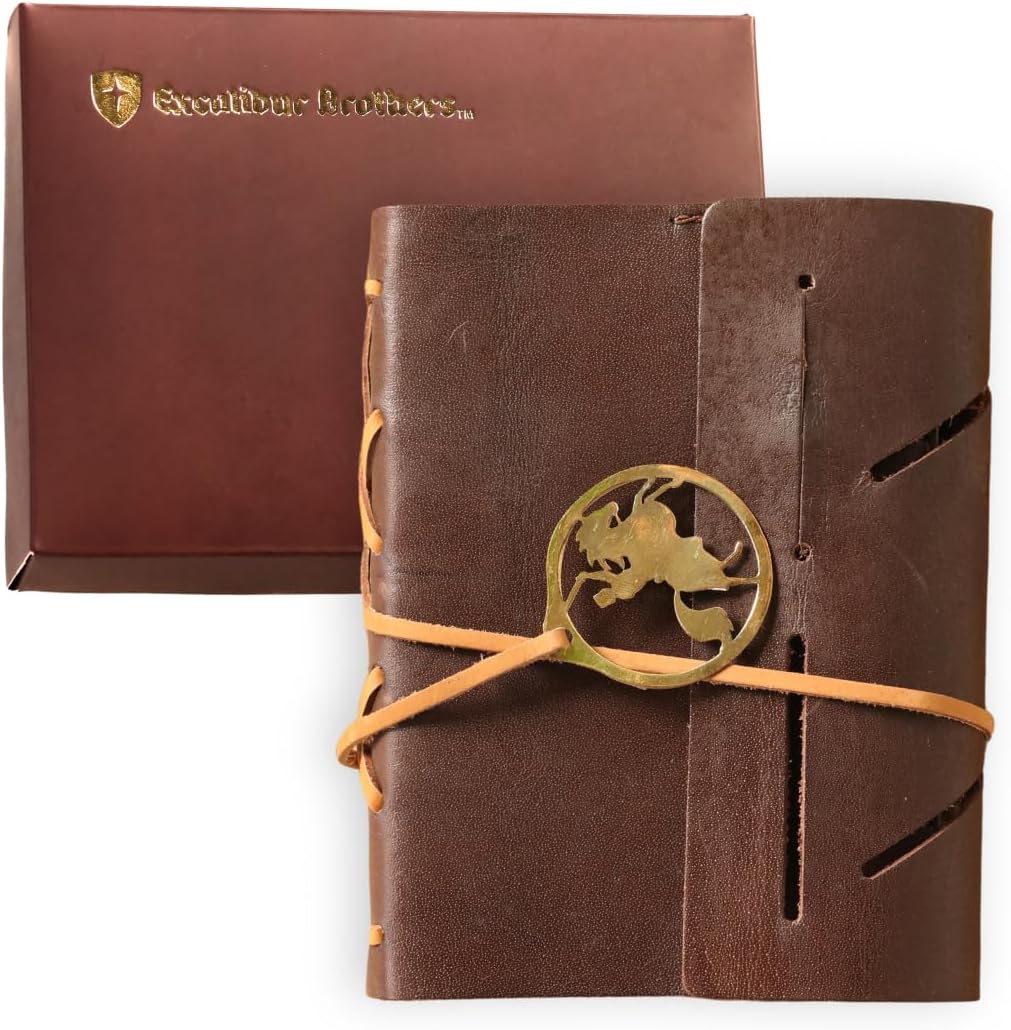
Ours is built for the carry instead. The Excalibur Brothers leather journal is A6, 4.3 × 5.9 inches, in a dark brown buffalo leather cover with a pen loop and a bookmark. The 100-page ivory insert swaps out when it's full, so the cover is a one-time purchase and everything after that is paper. It ships in a keepsake box, which matters if it's going to somebody else. It's $14.95 and holds 4.6 stars from 7 Amazon ratings, which is a small enough sample that I wouldn't read much into it either way.
Real buffalo hide needs occasional attention, though much less than people expect: see how to condition leather for the once-or-twice-a-year routine.
Start tonight, badly
Date the page, set a timer for five minutes, and write what happened today in whatever order it comes out. Do that four times this week. On the fifth entry you'll stop thinking about whether you're doing it right, which is the only milestone that matters.
If you're buying one for someone else, the journal shows up on both our gifts for writers list and the wider men's gifts guide, and the keepsake box means it needs no wrapping.
Journaling FAQ
What do I write in my journal first?
The date, then what you did today in order, with no commentary. A log is the easiest first entry because it needs no self-examination and no introduction. Three or four lines is a complete entry. Don't write a preamble explaining why you're starting a journal; nobody is reading it.
What is the 3-2-1 method of journaling?
A six-line template: three things that went right today, two things you learned or got done, one thing to fix tomorrow. It takes about four minutes and removes the blank-page problem. Treat it as a format rather than a rule, and swap line one to "three things that happened" on bad days.
How long should journaling take?
Five minutes. Set a timer and stop when it goes, even mid-sentence. The cap is what keeps the habit alive on the days you don't feel like it. Expressive-writing studies ran fifteen to thirty minute sessions, but that was a short course of one to five sessions, not a daily habit, and neither session length nor session count predicted how well it worked.
Should I journal in the morning or evening?
Evening, if you can hold it. You still have the day's detail in your head and the entry doubles as a way to shut the day down. Choose morning if you're reliably asleep early, and write about yesterday. The consistent slot matters more than which one you pick.
Sources
Every figure, rule and date above traces to one of these. We link the body that issued it, never someone's summary of it, and we don't link anyone who sells what we sell.
- British Journal of General Practice (open access via PubMed Central), Making health habitual: the psychology of 'habit-formation' and general practice. Gardner B, Lally P, Wardle J. Making health habitual: the psychology of 'habit-formation' and general practice. Br J Gen Pract. 2012 Dec;62(605):664-666. doi:10.3399/bjgp12X659466. PMID: 23211256. PMCID: PMC3505409. Checked 20 Sep 2026.
- Journal of Abnormal Psychology (PubMed record, US National Library of Medicine), Confronting a traumatic event: toward an understanding of inhibition and disease. Pennebaker JW, Beall SK. Confronting a traumatic event: toward an understanding of inhibition and disease. J Abnorm Psychol. 1986 Aug;95(3):274-281. doi:10.1037/0021-843X.95.3.274. PMID: 3745650. Checked 20 Sep 2026.
- Journal of Consulting and Clinical Psychology (full PDF hosted by Stanford SPARQ, Stanford University), Written emotional expression: effect sizes, outcome types, and moderating variables. Smyth JM. Written emotional expression: effect sizes, outcome types, and moderating variables. J Consult Clin Psychol. 1998 Feb;66(1):174-184. doi:10.1037/0022-006X.66.1.174. PMID: 9489272. Checked 20 Sep 2026.
- Psychological Bulletin (American Psychological Association), Experimental disclosure and its moderators: a meta-analysis. Frattaroli J. Experimental disclosure and its moderators: a meta-analysis. Psychol Bull. 2006 Nov;132(6):823-865. doi:10.1037/0033-2909.132.6.823. PMID: 17073523. Checked 20 Sep 2026.
- Journal of Experimental Psychology: Human Perception and Performance (American Psychological Association), The attentional cost of receiving a cell phone notification. Stothart C, Mitchum A, Yehnert C. The attentional cost of receiving a cell phone notification. J Exp Psychol Hum Percept Perform. 2015 Aug;41(4):893-897. doi:10.1037/xhp0000100. PMID: 26121498. Checked 20 Sep 2026.
Read next
Refillable Leather Journal: Keep the Cover, Swap the PagesA refillable A6 leather journal: buffalo leather cover, 100-page ivory insert, pen loop, box. Keep the cover,

Pocket Notebooks That Actually Fit in a Back PocketTen pocket notebooks compared on size, pages, cover and price, with the pocket each one actually fits: back je
Pocket Notebook Sizes in mm, Because A6 Labels VaryPocket notebook sizes in millimetres and inches, A7 to B6, which pocket each one fits, and why an A6 on a labe