A Leather or Stainless Steel Flask Holds the Same 304 Steel
Choose a leather-wrapped flask if you want grip and a gift-box look; choose bare stainless if you want the lightest, cheapest, wipe-clean option. Both hold the spirit in the same 304 steel. The leather vs stainless steel flask decision is about the outside of the flask and nothing else.
Most of what's written on this says leather does something to the whisky. It doesn't.
Compared from published specs, seller listings and owner reviews, not from a season of carrying six flasks.
Leather vs stainless steel flask: they're the same inside
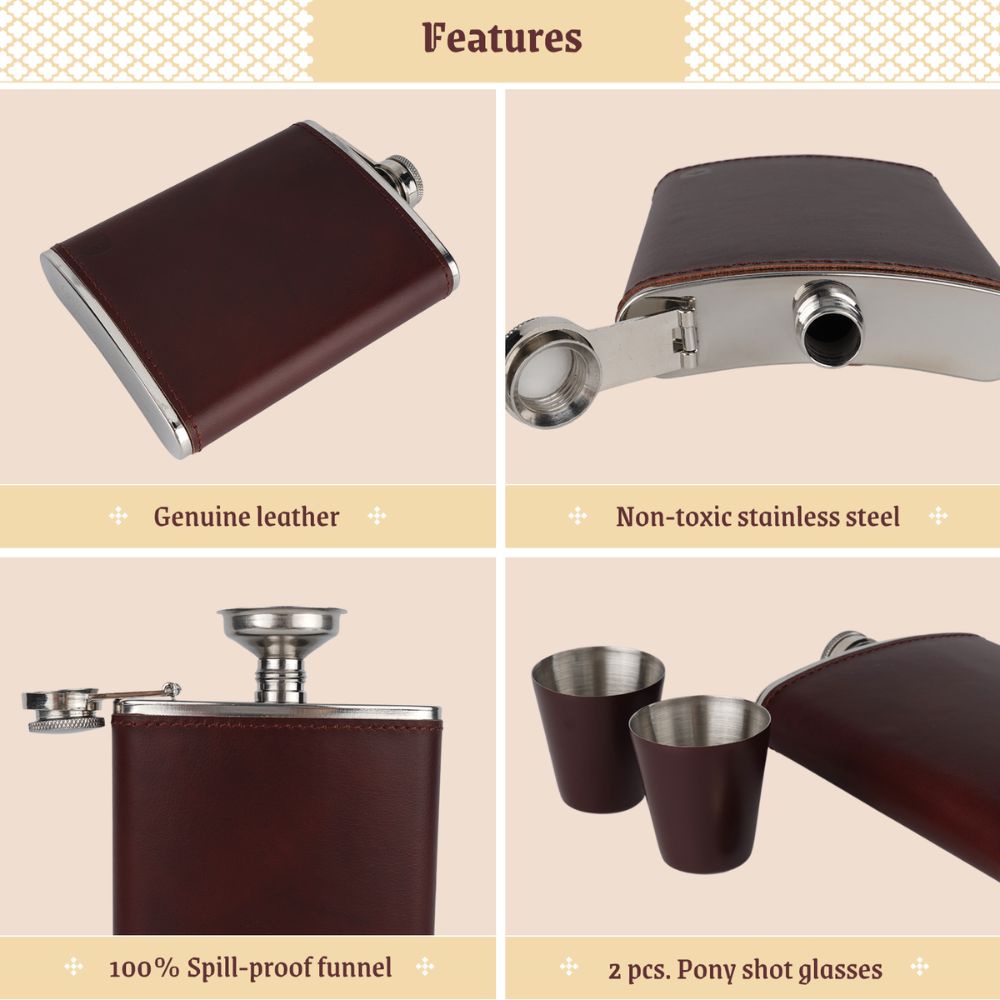
The liner does the work. Pick up almost any leather flask and you're holding a stainless steel hip flask with a cover on it. The wrap is glued or stitched around a welded steel body, usually 304, sold as 18/81. The spirit touches steel, a gasket and a cap. Never the leather.
So the old line about leather preserving flavor is wrong, and we published a version of it ourselves years ago. Leather can't protect a spirit it never meets. What keeps bourbon tasting like bourbon is that 304 stainless holds a passive chromium-oxide film and sits close to inert at the acidity of spirits. Close to, not perfectly: researchers who simmered acidic food in stainless pans for hours measured nickel and chromium migrating2 into it, and the food-contact rule3 the grade is built to asks for migration low enough to be harmless, never for zero. A cold flask you empty the same night is the opposite of a simmering pan. Bare steel does that as well as wrapped steel.
Same for temperature. There's no vacuum wall in a hip flask, and a millimeter of hide or polyurethane insulates about as well as a business card. In an inside pocket, a flask goes to body temperature either way.
The myth has a real ancestor: medieval costrels and blackjacks were hide vessels, lined inside to hold liquid, and those did flavor what went in them.
One exception: a few leather flasks are a glass bottle in a sleeve, which is what Clayton & Crume sells as its Original Glass Flask. Read the listing.
PU leather wraps vs hide wraps
Not all leather wraps are leather. Ours isn't, and we'd rather say so than have you find out.
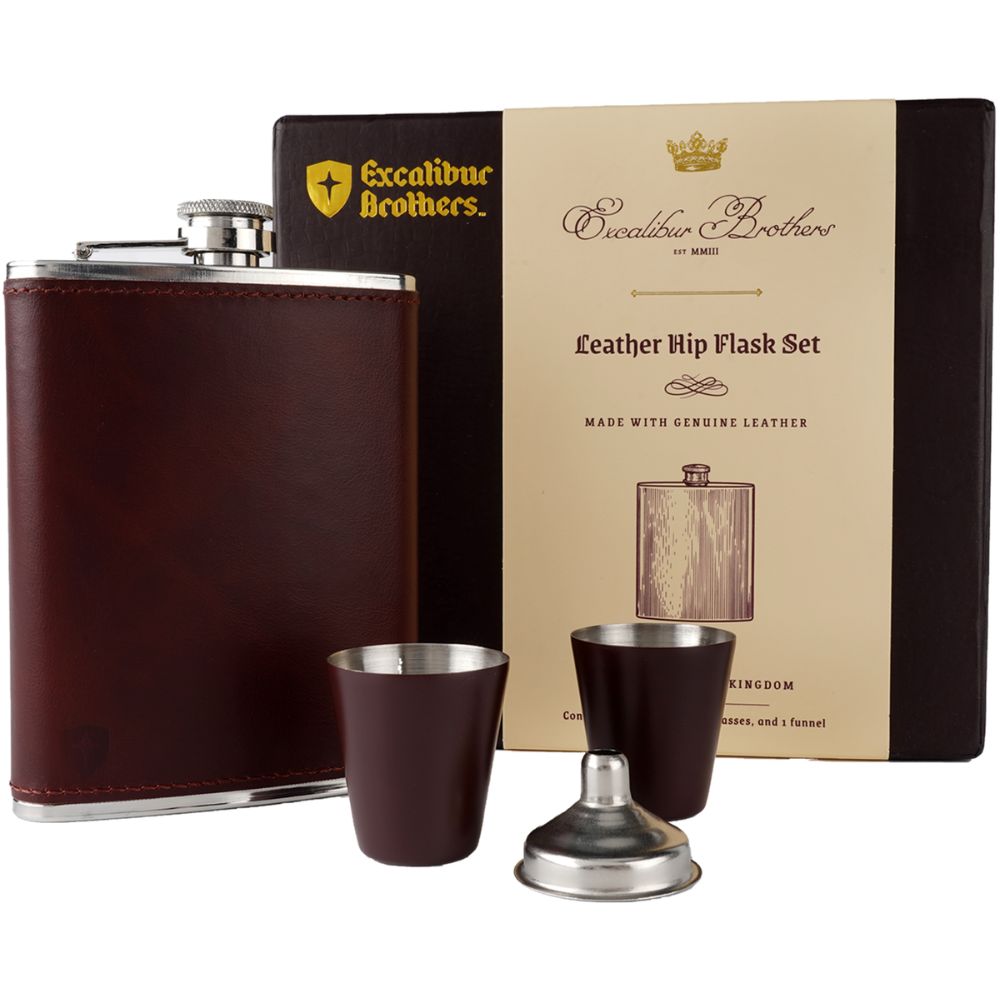
PU leather, the wrap on the Excalibur Brothers flask, is polyurethane over a fabric backing. It wipes clean, never needs conditioning, won't darken or take a patina, weighs less than hide, costs a fraction of it, and shrugs off spilled rye that would stain the real thing.
Hide wraps are what Will Leather Goods, Shinola and Clayton & Crume sell. Vegetable-tanned hide darkens where your hand sits and wants conditioning once or twice a year. It costs several times more, and it drinks up whatever you spill on it.
A seller who won't say which one you're buying has told you something. "Leather look", "PU", "bonded" and "vegan leather" all mean synthetic.
Grip and feel: where a leather flask genuinely wins
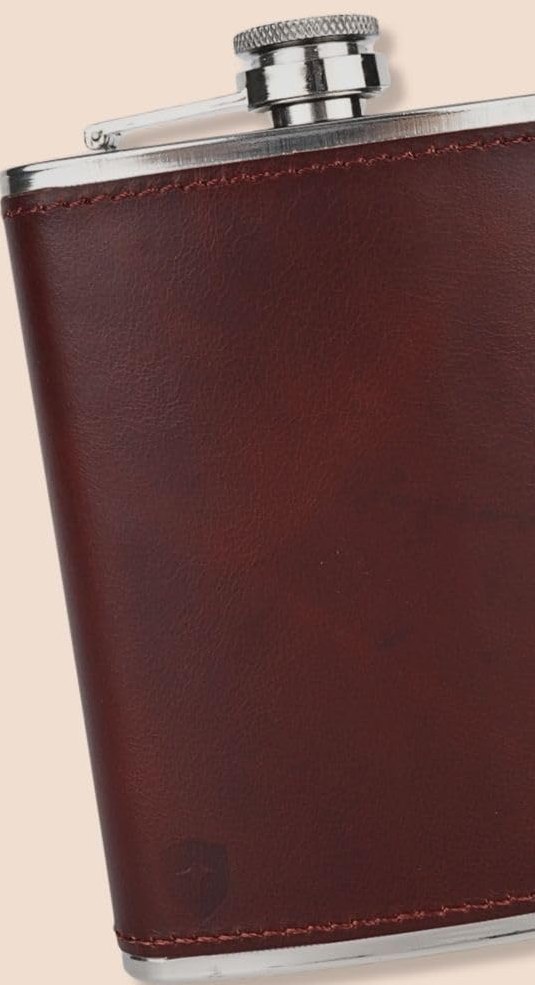
The real argument for a wrap, and the old post got this one right. Bare stainless in November is slippery and cold, especially through gloves. Wrapped, it warms to the hand in seconds and has friction to it.
Bare steel reads as equipment; a wrapped flask reads as a present. That's why wrapped ones fill the gift listings.
How each one ages
Bare stainless keeps every mark. Drop it on concrete once and the dent is the flask's biography now. Polished finishes scratch faster than brushed, so buy brushed if that bothers you.
PU holds its appearance for years, then lets go at the edges, usually at a corner or a flexing seam. Heat speeds it up; a car dashboard in August is the worst of it.
Hide goes the other way and improves, until it dries out and cracks, which is what conditioning prevents.
Care: cleaning a leather vs stainless steel flask
The steel is identical work either way. Warm water, one drop of dish soap, three rinses, dry it upside down with the cap off. The full routine, including the whiskey-smell fix, is in how to clean a hip flask.
The outside splits them. Bare steel takes anything short of bleach and an abrasive pad. PU takes a damp cloth and nothing else: no conditioner, no solvent wipes. Hide takes a barely damp cloth and a conditioner twice a year.
Neither goes in the dishwasher: heat and detergent lift a wrap off the steel for good.

Weight and pocket: what a wrap adds to a stainless steel hip flask
A few grams and roughly a millimeter per side. In a jacket you'll never notice. In a shirt pocket you will, because that millimeter decides whether the flask sits flat or prints through the fabric.
Capacity matters more than the wrap. An 8 oz flask is the top of the pocket range; 6 oz disappears more easily.
The other three materials, briefly
Pewter. Heavy, soft, traditional, expensive for what it does. Modern pewter is lead-free and food-safe, but it dents if you look at it.
Glass. You can see the level and it adds nothing to the taste. It also breaks, which is why glass flasks ship inside a sleeve.
Titanium. Lighter than steel at the same strength and completely non-reactive. Several times the price of good stainless, for a difference you feel mainly on a long hike.
| Material | Grip | Care | How it ages | Weight | Street price | Best for |
|---|---|---|---|---|---|---|
| PU-wrapped steel | Good | Wipe | Steady, then peels at edges | Light | $20–45 | Gifts, daily carry |
| Hide-wrapped steel | Best | Condition twice a year | Darkens, improves | Light | $60–150 | Keeping for decades |
| Bare stainless | Poor when cold | Soap and water | Scratches, dents | Lightest | $6–35 | Pockets, hard use |
| Pewter | Fair | Polish | Dents, dulls | Heavy | $40–120 | Heirloom looks |
| Glass in a sleeve | Good | Hand wash, carefully | Sleeve ages, glass doesn't | Medium | $35–125 | Seeing what's left |
| Titanium | Poor when cold | Soap and water | Barely changes | Very light | $26–180 | Backpacking |
Street prices are typical US retail, not quotes.
Verdict by use
Daily carry. Bare stainless, brushed, 6 oz. Cheapest of the lot, and you won't grieve it when it goes.
A gift. Wrapped, in a box. The wrap and the packaging are the reason it reads as a present. Ours ships with two pony cups, a funnel and a wooden case at $34.95. If you want the field compared instead, see our best hip flask picks.
Hiking. Titanium if grams matter, bare stainless if they don't. A wrap soaks through in a rain shell pocket and stays damp.
A wedding. Wrapped, one per groomsman. Check the venue's rules on outside alcohol before you hand them out; open-container laws4 vary by state and venue, and this isn't legal advice.
Everything else about carrying and filling one is in the hip flask guide.
Flask material FAQ
What material is best for a flask? Stainless steel, 304 or 316, for the body. It's non-reactive and it won't rust, and it's cheap enough to be built well at a normal price. Leather, PU, silicone and pewter sleeves are covers over that body. Choose the cover for grip and looks, not for what it does to the drink.
Are titanium flasks better than stainless steel? Better on two counts: lighter for the same strength, and completely inert. Worse on one: several times the price. For a flask that lives in a jacket pocket, the weight saving is a few grams and hard to justify. For a multi-day hike, it's a real argument.
How long can you keep alcohol in a stainless steel flask? Days, not months. High-proof spirits won't spoil in 304 stainless, but they go flat and dull5 in a part-full flask as the air in it does its work. Never store anything with sugar, dairy, citrus or carbonation. Empty it, rinse it, dry it open.
Sources
Every figure, rule and date above traces to one of these. We link the body that issued it, never someone's summary of it, and we don't link anyone who sells what we sell.
- University of Cambridge — Phase Transformations and Complex Properties Research Group, Stainless Steels. Checked 20 Sep 2026.
- Journal of Agricultural and Food Chemistry (via PubMed Central, NIH), Stainless Steel Leaches Nickel and Chromium into Foods during Cooking. Checked 20 Sep 2026.
- U.S. Food and Drug Administration / U.S. Public Health Service, FDA Food Code 2022 — § 4-101.11 Characteristics (Multiuse materials for construction and repair). Checked 20 Sep 2026.
- Legal Information Institute, Cornell Law School, 23 U.S.C. § 154 — Open container requirements. Checked 20 Sep 2026.
- National Library of Medicine, PubMed Central (Foods, 2022), Influence of the Storage in Bottle on the Antioxidant Activities and Related Chemical Characteristics of Wine Spirits Aged with Chestnut Staves and Micro-Oxygenation. Checked 20 Sep 2026.
Read next
What a Hip Flask Is For and Whether Carrying One Is LegalWhat a hip flask holds, what to put in one, how long spirits keep inside it, how to fill and carry it, and whe
How to Clean a Hip Flask and Get the Whisky Smell OutHow to clean a hip flask: warm water, one drop of soap, three rinses, then dry it cap off and upside down. Wha
The 10 Best Hip Flasks, Compared by Price, Size and ClosureTen hip flasks compared on capacity, body material, closure and list price, with picks for best overall, best