How to Clean a Hip Flask and Get the Whisky Smell Out
To clean a hip flask, fill it halfway with warm water and one drop of dish soap, cap it, and shake it for ten seconds. Dump that out, then rinse three times with plain warm water until no suds come out. Stand it upside down with the cap off until the inside is dry.
That's the whole job. The part people get wrong is the last sentence.
How to clean a hip flask, step by step
Empty it and rinse hot, the same day. Pour out whatever's left, then run hot tap water through it twice and dump it. What goes wrong: whiskey that dries in a flask leaves a sticky film on the shoulders where you can't see it, and once it hardens, soap and water won't touch it. Now you need the overnight soak for something a 20-second rinse would have handled.
One drop of dish soap. One. Half-fill with warm water, add a single drop, cap it. What goes wrong: more soap feels more thorough. But a flask has a narrow neck and no way to get a cloth inside, so every extra bubble is one you now have to rinse back out. Your next pour tastes like the sink.
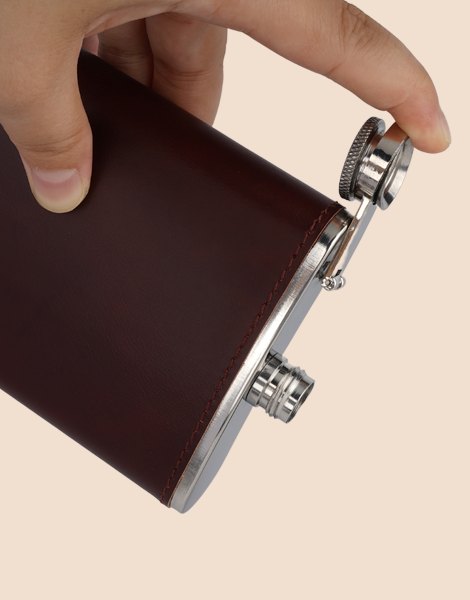
Shake it for ten seconds. Hard, with your thumb over the cap. If the flask has been sitting for a few weeks, leave the soapy water in it for five minutes first, then shake. What goes wrong: a gentle swirl only washes the bottom third. Residue lives up on the shoulders and behind the neck, and that's the part that smells.
Rinse three times, not once. Plain warm water: fill, shake, dump. Repeat until what comes out is flat and clear. What goes wrong: one rinse leaves soap on the steel. You won't see it, you'll taste it, and you'll blame the whisky.
Wipe the outside with a damp cloth. Barely damp. Go around the wrap, the seam, and the cap hinge, where spills collect. What goes wrong: a soaking cloth pushes water under the edge of the wrap, the one spot on the flask that doesn't dry fast.
Dry it upside down with the cap off. Overnight. Stand it on a dish rack so the neck points down. What goes wrong: this is the mistake everyone makes. Cap it with water still inside and you've built a sealed, damp box. It comes out of the drawer three weeks later smelling like a wet basement.

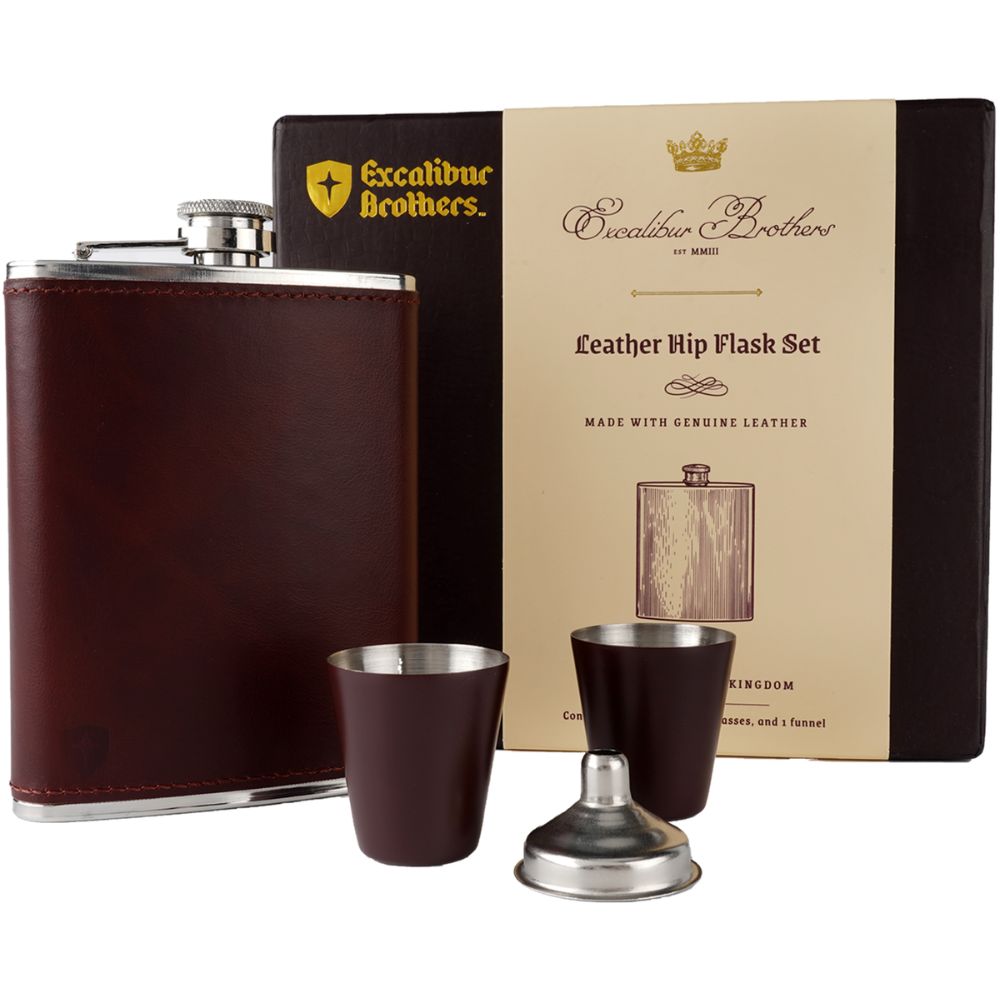
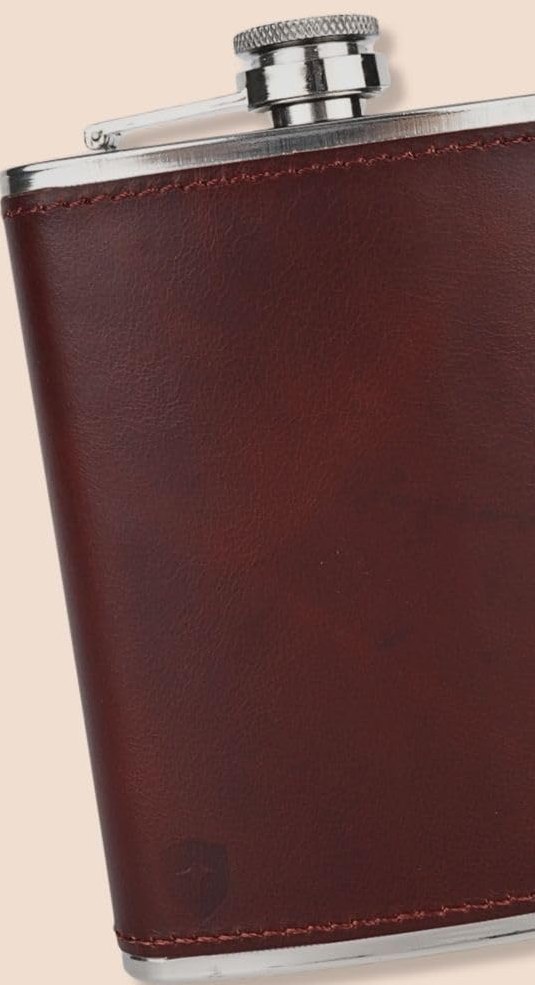
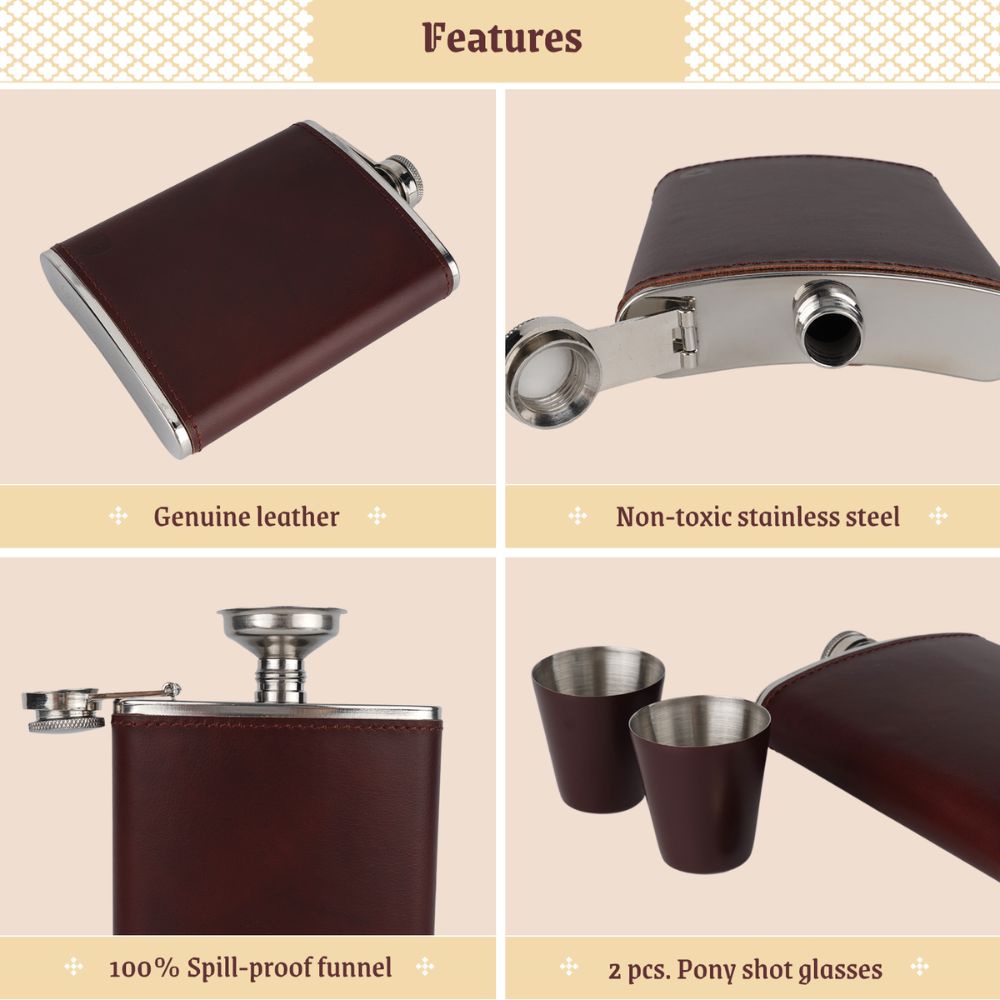
Our leather flask is 304 stainless steel, laser-welded, with no liner and no plastic insert. That matters more on cleaning day than anything else on the box: no coating to strip, no lining to peel, nothing porous for whisky to soak into.
What never to use
Bleach. Chlorides pit stainless steel. The damage is microscopic and permanent, and pitted steel holds residue better than smooth steel, so every future cleaning gets worse. Nothing you'd put in a flask needs bleach to get it out.
The dishwasher. Two problems at once. A flask goes in neck-down and never drains or dries properly, and the wrap on a leather-look flask is glued or stitched to the steel with adhesive that a hot cycle and a detergent jet will lift. Hand wash it.
Abrasive pads and stiff brushes on the wrap. The wrap is a thin polyurethane skin. Scour it and it goes pale and fuzzy, and there's no way to buff that back.
Vinegar left to sit. A short vinegar rinse for hard-water haze is fine. Filling the flask, capping it, and forgetting it until Sunday is not. Stainless steel protects itself with a thin oxide layer that needs air to repair1, and a capped flask full of acid is where it can't. Rinse, dump, rinse with water.
The PU leather wrap
The wrap is PU leather: polyurethane over a fabric backing. Not hide, which is good news on cleaning day. A damp cloth takes off fingerprints and spills, a drop of mild soap on the cloth handles anything greasier, then dry it with the other end of the towel.
Skip the conditioner. Conditioner replaces oils that animal hide loses over time, and polyurethane has no oils to replace. It sits on the surface, goes tacky in a warm pocket, and collects lint. Same reason PU never develops a patina, and the same reason it shrugs off a spill that would stain hide.
If your flask is wrapped in actual hide, which some are, that's a different routine: conditioning leather is its own job.
Getting the whiskey smell out
Put a teaspoon of baking soda in the flask, top it with warm water, and leave it overnight with the cap off so it can vent. Dump it in the morning, rinse three times, dry it upside down. That clears most of it.
If the smell survives that, rinse with cheap vodka. Pour in an ounce, swirl it around the shoulders, dump it, rinse with water, dry. Neutral spirit strips aromatic oils that water leaves behind, which is why it works on peated whisky when soap doesn't.
The real fix is upstream: don't store spirits in a flask for weeks. A flask carries a drink, it doesn't age one. Whisky left for a month goes flat and stale, and cream liqueurs or anything with juice or sugar in it leaves a film that takes three cleanings to shift. See what to put in a hip flask for the drinks that behave.
How often should you clean a hip flask
Rinse after every use, clean properly after every fill that sat more than a few days, and always before it goes into a drawer for the season. Storing a flask empty, dry, and uncapped is the one habit that keeps it from ever needing the baking soda treatment.
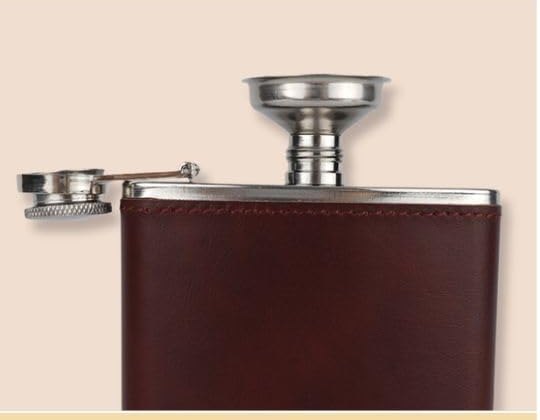
Filling it cleanly helps. Most of what ends up on the outside of a flask arrives during the pour, which is the argument for a funnel, or the paper-cone trick when you don't have one. The rest of the basics live in the hip flask guide.
Hip flask cleaning FAQ
How do you clean the inside of a hip flask? Warm water and one drop of dish soap, capped and shaken for ten seconds, then three plain-water rinses until no suds come out. Nothing goes inside a flask that you can't get back out again, so skip brushes with loose bristles. Dry it upside down with the cap off.
Are hip flasks hygienic? A dry flask is. Spirits at 40% ABV and up don't support much growth2, and bare stainless is nonporous, so there's nothing for a film to sink into and it rinses clean. Nonporous is not the same as bacteria-proof, and anyone who tells you steel repels them is overselling it: given water and time, bacteria build a film on stainless3 the way they build one on anything left wet. The problem is never the spirit. It's water or a sugary mixer sitting in a capped flask for a month. Empty it, rinse it, dry it open.
What is the best way to clean the inside of a flask? For routine cleaning, soap and warm water. For build-up you can smell, a teaspoon of baking soda topped with warm water and left overnight with the cap off, or a denture tablet, which does the same job. For something stubborn, uncooked rice and warm soapy water, shaken hard, scours what you can't reach.
Sources
Every figure, rule and date above traces to one of these. We link the body that issued it, never someone's summary of it, and we don't link anyone who sells what we sell.
- U.S. Naval Academy — EN380 Naval Materials Science and Engineering, Chapter 2 — Corrosion and Electromotive (Passivating films; Concentration Cells). Checked 20 Sep 2026.
- Centers for Disease Control and Prevention, Chemical Disinfectants — Guideline for Disinfection and Sterilization in Healthcare Facilities (Alcohol). Checked 20 Sep 2026.
- Brazilian Journal of Microbiology (via PubMed Central, NIH), Biofilm formation by Listeria monocytogenes on stainless steel surface and biotransfer potential. Checked 20 Sep 2026.
Read next
What a Hip Flask Is For and Whether Carrying One Is LegalWhat a hip flask holds, what to put in one, how long spirits keep inside it, how to fill and carry it, and whe
Hip Flask Sizes in oz and ml, and How Many Shots Each HoldsHip flask sizes from 1 oz to 64 oz in ounces and millilitres, how many shots each holds, typical dimensions in
What Should You Put in a Hip Flask So the Taste Holds Up?What to put in a hip flask: four spirits that hold up at body temperature, what never goes in, how long alcoho