How to Wear a Hip Flask, Which Pocket and Which Way Up
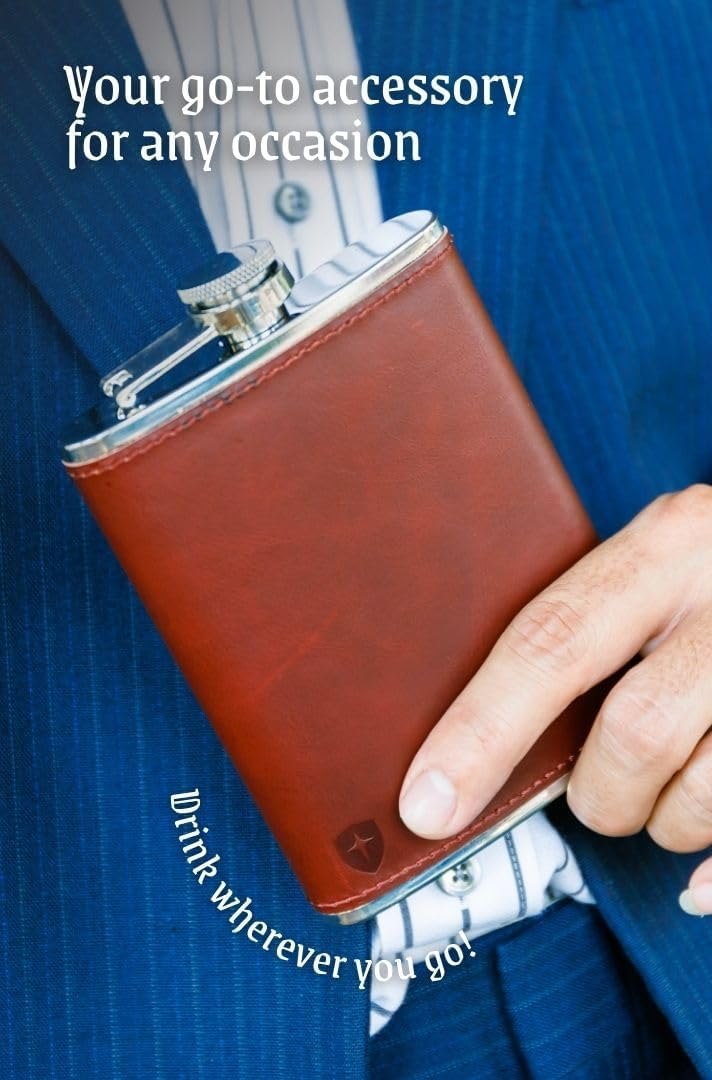
Wear a hip flask in the inside breast pocket of a jacket, or in a back hip pocket with the curved side against your body. Cap up, either way. A flat 6 or 8 oz flask disappears under a blazer. Anything larger belongs in a coat pocket or a bag.
Where to wear a hip flask
Inside breast pocket of a jacket. The best spot, and the reason flasks are shaped the way they are. Weight sits high and flat against your chest, the jacket hangs straight, nobody sees an outline. Six or eight ounces fits. Check the pocket is sewn into the lining, not just a slit.
Back trouser pocket. Where the hip in hip flask comes from. Curve against your hip, cap toward the waistband. You will sit on it, so take it out before dinner.
Front trouser pocket. Fine up to about four ounces. An 8 oz flask in the front of your jeans looks exactly like an 8 oz flask in the front of your jeans.
Coat pocket. Any size, one risk: coats get checked, hung elsewhere, and left behind.
A boot. Boot flasks are real: narrow, curved to the shaft of a cowboy boot. They work if your boots have the room; for most people, a costume choice.
A bag. Fine for a hike, though you aren't wearing it.
Our hip flask sizes guide maps ounces to pockets.
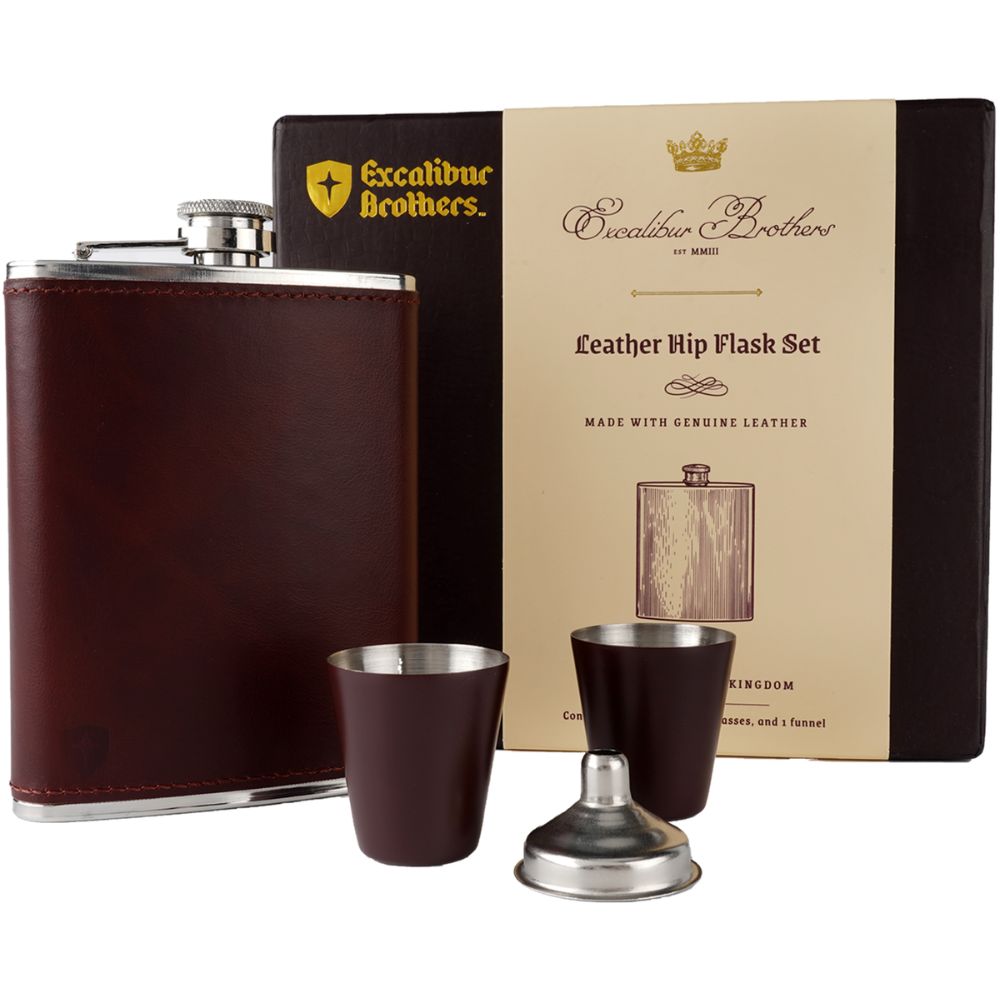
Our leather flask is 8 oz, 304 stainless steel under a PU leather wrap: the size that works in a jacket and doesn't in slim jeans. It ships with a funnel, two roughly 1 oz pony cups and a wooden case.
Curved vs flat, and which way the curve faces
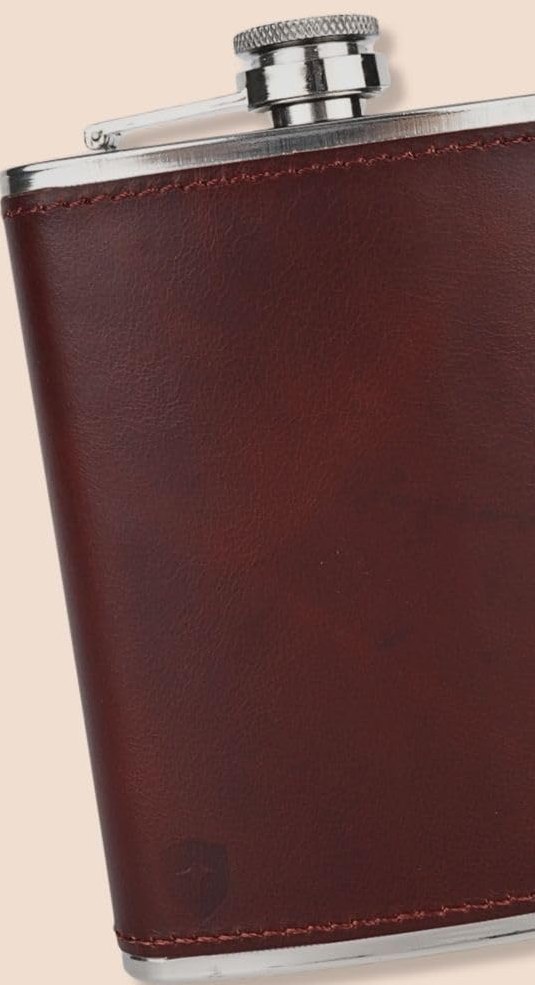
The kidney curve has a job. A flask flat on both faces sits on your hip like a hardback book, one edge pressing in every time you move. The concave face follows the body and lies down against it.
Concave side in, convex out. On a hip the hollow faces your leg; in a breast pocket, your chest. Backwards, and the thing rocks on its own belly all night. Flat-sided flasks are slimmer front to back, which reads better under a close-cut jacket, but past an hour on a hip the curved one wins.
Cap up, always. If the cap isn't fully seated, gravity finishes the argument, and a jacket lining is an expensive place to find that out.
Hip flask etiquette: when to offer, when to leave it in your pocket
One rule under the rest: if you wouldn't offer it to the person next to you, don't take it out.
Never where they sell drinks. A bar, someone else's bar, a stadium concourse, a wedding with an open bar. You're drinking past the host's tab and past the venue's liquor license, and staff who spot it can take it off you.
Weddings. Open bar, leave it in the car. An outdoor ceremony in March, forty minutes of photos, nothing pouring yet: that's the job. Offer it down the line before your second pull.
Funerals. Graveside, cold, nobody saying much. One of the few places a flask is unambiguously welcome, provided it goes around quietly and nobody makes a speech about it.
The 10 a.m. question. The clock matters less than who's standing near you. Tailgate at nine, ski lift at ten, a duck blind before sunrise, the cold end of a parade route: nobody blinks. The same flask at your desk is a different conversation.
What's in it. Nobody wants a warm mouthful of something sweet. Whiskey, bourbon, brandy and rum all travel well, and what to put in a hip flask covers the ones that don't.
The legal bit
Open-container rules are state and city law and they don't agree. A filled flask has a broken seal on it, which is the test most of those statutes apply, so treat it as open until you know better.
In a car, most states ban open containers1 anywhere in the passenger compartment, driving or riding. On the street it varies, and the famous exceptions are narrower than their reputation. New Orleans has no pedestrian open-container ban, but it does ban glass containers downtown. Savannah's Historic District allows one drink outdoors only in a paper or plastic cup of 16 oz or less, bought from a licensed bar: a flask is not a cup and is not carved out there.
Stadiums and festivals run on bag policy and pat-downs, where getting caught costs the ticket rather than a citation. Transit systems each set their own. Flying, the 3.4 oz TSA limit stops a full 8 oz flask at security, and you can only drink what the crew served you.
None of this is legal advice, and for an unfamiliar venue its own website beats anything else you'll turn up.
Pick the pocket that fits your flask, keep the curve against you, offer it before someone asks, and read the room. Our hip flask guide covers choosing, filling and cleaning one.
How to wear a hip flask: FAQ
Do people still use hip flasks? Yes, mostly outdoors and mostly in places where drinks aren't being sold: tailgates, ski lifts, golf courses, cold outdoor weddings. They're also a standing groomsman gift, which is why so many of the ones in circulation have somebody's initials engraved on them.
Is it illegal to carry around a flask? Carrying one is legal almost everywhere in the US. Drinking from it is the regulated part. Open-container laws cover streets, parks and the inside of a car, and they're written state by state. Venues layer their own rules on top.
What is a hip flask used for? Carrying a few ounces of spirits somewhere a bottle won't go, like a stadium seat, a ski lift, a long walk or a graveside. Eight ounces is about five 1.5 oz pours, which is a couple of drinks shared standing up.
Sources
Every figure, rule and date above traces to one of these. We link the body that issued it, never someone's summary of it, and we don't link anyone who sells what we sell.
- Legal Information Institute, Cornell Law School, 23 U.S.C. § 154 — Open container requirements. Checked 20 Sep 2026.
Read next
What a Hip Flask Is For and Whether Carrying One Is LegalWhat a hip flask holds, what to put in one, how long spirits keep inside it, how to fill and carry it, and whe
Leather Flask, 8 oz: Two Cups, a Funnel and 304 Steel304 stainless inside a smooth leather wrap. 8 oz, two pony cups, a funnel and a wooden case. $34.95, 4.6 stars
Hip Flask Sizes in oz and ml, and How Many Shots Each HoldsHip flask sizes from 1 oz to 64 oz in ounces and millilitres, how many shots each holds, typical dimensions in